Pixels Fund was my attempt to turn trading ideas into software I could test, run, and pick apart. It did more than $1 million in trading volume on Coinbase.
I developed trading algorithms, built a backtesting framework, and experimented with training custom machine-learning models. A lot of the work was the infrastructure around those experiments: getting market data in, running the same rules repeatedly, and seeing exactly what a bot had done.
A strategy needs rules.
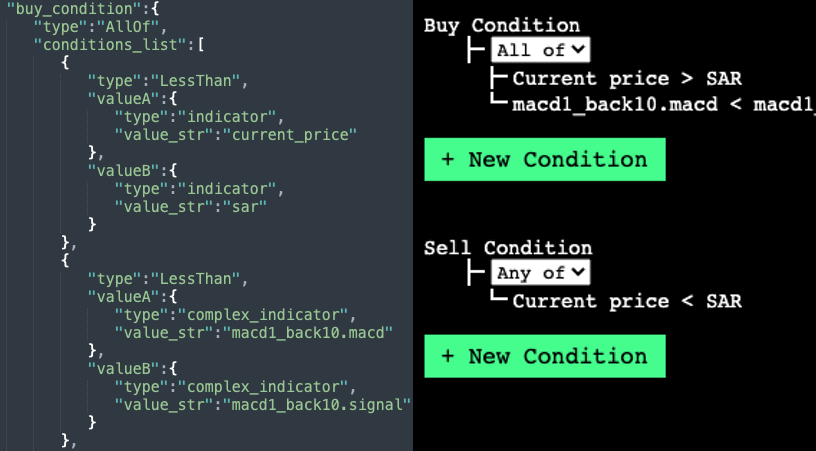
“Buy when it looks cheap” isn’t something a bot can execute. The strategy builder turned an idea into explicit buy and sell conditions. Conditions could be grouped with “all of” or “any of,” then saved in a structured format that the strategy code could read.
The editor at the top of this page shows both sides: the configuration and the interface for composing it.
The rest of the machine.
The system grew into a bot runner, a backtester, indicator services, and live streams for price bars and the order book. The repository also includes Kraken order integration alongside the Coinbase work. A frontend let me manage bots and inspect their orders.
The ML experiments added another set of moving parts: preparing historical trades, generating different kinds of price bars, training models, and evaluating predictions. Writing a model was only one step. It still had to fit into a system that could turn its output into a decision.
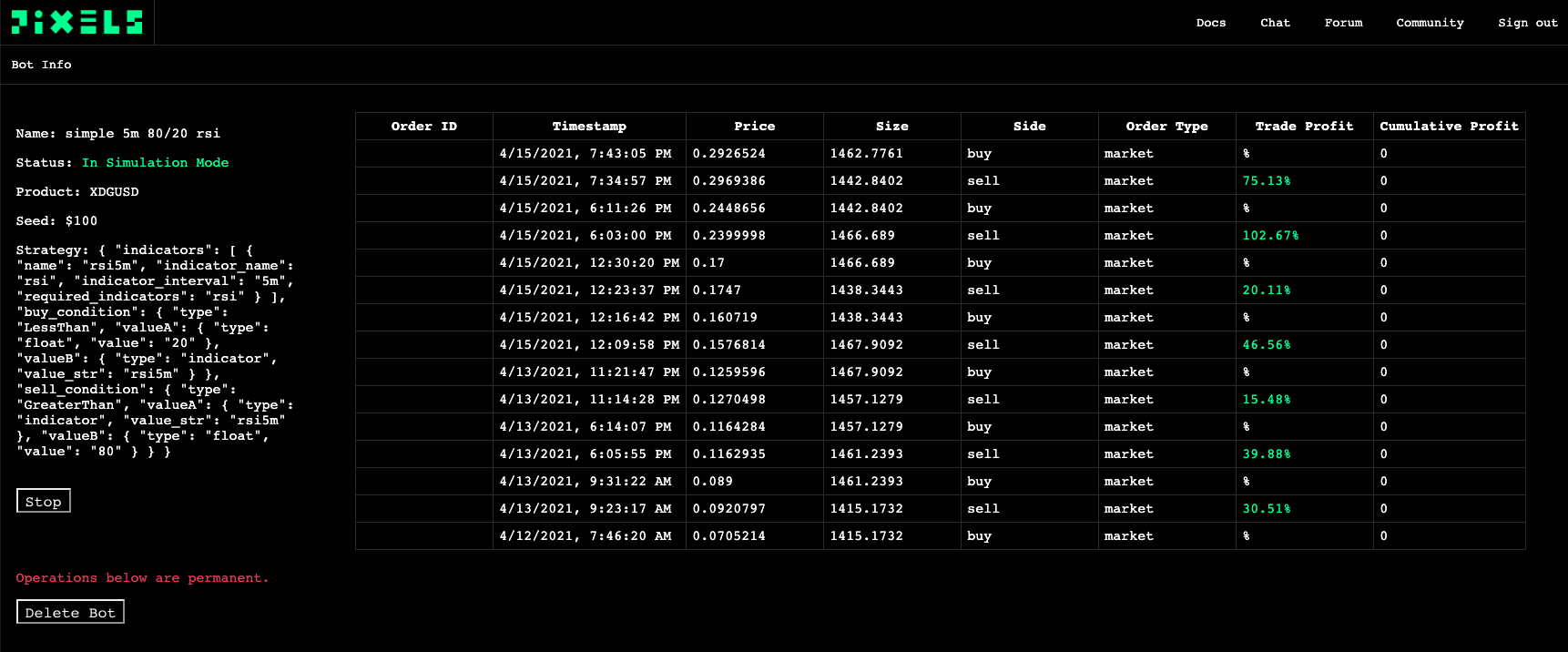
Can I trust the backtest?
The early backtester accounted for taker fees, but used simplified fill prices. There’s even a TODO in the code for better slippage modeling. That detail matters: a simulated order and an order that actually fills are different things.
A later experimental pipeline makes those questions more explicit. It separates training, validation, and test periods in time, includes transaction costs, and checks how sensitive a result is to small changes in the settings. Those are checks on the experiment, not proof that a strategy will keep working.
That’s the interesting part of this project for me: an idea has to survive the data, the simulator, and the actual exchange. Each gives it another chance to be wrong.
Screenshots from the original Pixels Fund application.